


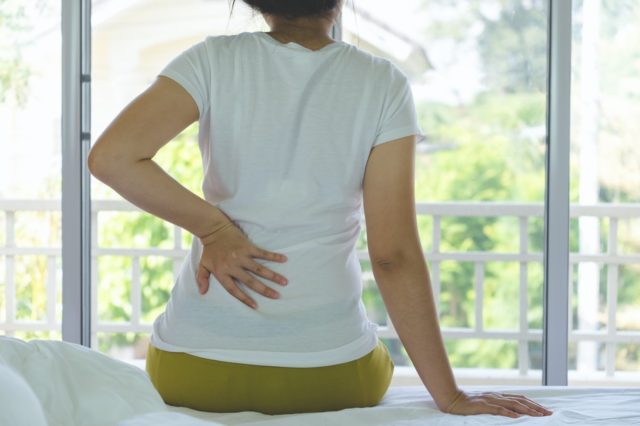
For millions of adults over the age of 60, the day often begins and ends with the same familiar, nagging companion: lower back pain. While many assume this is an inevitable byproduct of aging—a sign that the "warranty" on their spine has simply expired—the reality is often rooted in mechanical dysfunction rather than permanent structural decay.
After four decades as a personal trainer and 25 years leading TRAINFITNESS, one of the UK’s premier educational institutions for fitness professionals, I have observed a consistent pattern: back pain is rarely a "back" problem. It is a symptom of what occurs elsewhere in the kinetic chain. When we understand the source, we can resolve the pain, often in as little as 10 minutes a day using four simple standing exercises.
The Root Causes: Why the Back Takes the Fall
To understand why your back aches, we must look at how the human body adapts to the modern sedentary lifestyle.
The "Folded" Pelvis
Decades of sitting—in office chairs, cars, and on sofas—keep our hip flexors in a chronically shortened, "folded" position. When we stand, these tight muscles act like bowstrings, pulling on the front of the pelvis. This forces the pelvis to tilt forward, creating an exaggerated arch (lordosis) in the lower back. This constant hyperextension compresses the spinal discs, leading to the localized pain that many mistake for a primary injury.

Gluteal Amnesia
The gluteal muscles are the body’s powerhouse, designed to handle the load of walking, lifting, and stabilizing the torso. However, prolonged sitting leads to "gluteal amnesia." Essentially, the brain stops prioritizing these muscles, leaving the smaller, weaker lower back muscles to pick up the slack. When the glutes fail to fire, every movement—from standing up to reaching for a cupboard—places an undue burden on the lumbar spine.
The Thoracic Stiffening
The middle of the back, known as the thoracic spine, is designed for rotation and extension. When this area becomes rigid from poor posture, the lower back attempts to compensate by moving further than it was ever meant to. A rigid upper back forces the lower back to become mobile and unstable; effectively, a "loose" thoracic spine is the best insurance policy for a "happy" lower back.
The Silent Loss of Core Stability
Perhaps most insidious is the age-related decline of the deep stabilizer muscles. After 50, if not actively maintained, these muscles fade. Without them, the spine loses its internal bracing system. Consequently, every twist or reach bypasses the musculature and lands directly on the passive structures—the ligaments and discs—of the spine.
Why Standing Exercises Are the Gold Standard
Traditional physical therapy often begins with floor-based exercises. While useful for acute recovery, they are often disconnected from the reality of daily life. We do not live our lives on the floor; we live them standing, walking, and reaching.
Standing exercises are superior for three reasons:
- Functional Alignment: By training in a standing position, you teach the body to stabilize the spine exactly where it is most vulnerable.
- Gravity as a Tool: Standing exercises load the spine with your own body weight, providing the necessary stimulus for muscles to strengthen and adapt.
- Low Barrier to Entry: Because these movements require no equipment and minimal space, they remove the "friction" that causes most people to quit their fitness routines.
The Four-Move Protocol: A Daily Routine
1. The Standing Hip Hinge
The hip hinge is the most fundamental movement pattern for a healthy back. It teaches you to fold at the hips—using the glutes and hamstrings—rather than rounding the lower back to pick up objects.
- The Technique: Stand with feet shoulder-width apart. Keep your spine neutral. Push your hips backward as if trying to close a door behind you with your glutes. Keep your shins vertical.
- The Goal: 12–15 repetitions.
- Pro Tip: Imagine you are a crane. Your torso should descend only as far as your hamstrings allow while maintaining a flat back.
2. Standing Single-Leg Hip Extension
This movement directly combats "gluteal amnesia" by isolating the glutes in a standing, weight-bearing position.
- The Technique: Holding onto a sturdy surface for balance, shift your weight to one leg. Keep the torso upright and slowly extend the other leg behind you, squeezing the glute muscle at the top of the movement.
- The Goal: 10 reps on each side.
- Focus: Ensure the movement comes from the hip, not from arching the lower back.
3. Standing Thoracic Rotation
This move addresses the stiffness between the shoulder blades, freeing the lower back from compensatory rotation.

- The Technique: Stand with feet wide, knees slightly soft. Place your hands on your shoulders. Rotate your upper torso gently to the right, then the left, keeping your hips facing forward.
- The Goal: 10 rotations per side.
- Note: This is a small, controlled movement. You are mobilizing the spine, not trying to twist into a pretzel.
4. Standing March with Reach
This exercise trains the deep core to stabilize the spine while the limbs are in motion—the exact scenario that causes back pain during daily activities.
- The Technique: March in place, lifting your knees to a comfortable height. As you lift the right knee, reach your left arm toward the ceiling. Alternate sides.
- The Goal: 20 reps total.
- Key Insight: The value lies in keeping the trunk steady and upright. Do not let your body sway side-to-side.
Chronology of Recovery: What to Expect
Commitment is the variable that determines success. While a single session may provide temporary relief, the long-term structural changes require consistency.
- Weeks 1–2 (The "Grumbling" Phase): You will notice the end-of-day ache begins to subside. This is the sign that your glutes are finally "waking up" and relieving the overworked lower back muscles.
- Week 4 (The Shift): Simple tasks—standing at the kitchen sink, grocery shopping, or exiting a vehicle—become noticeably easier. You will likely find that you are no longer reaching for painkillers after moderate activity.
- Weeks 6–8 (The New Baseline): The persistent, low-grade background pain often vanishes. Many patients report a "lightbulb moment" where they realize they have been living with chronic discomfort for years without fully acknowledging its impact on their quality of life.
Supporting Data and Clinical Implications
The efficacy of this approach aligns with modern kinesiology. According to studies in the Journal of Orthopaedic & Sports Physical Therapy, lumbar stability is not just about "strengthening the abs"; it is about the coordination of the entire posterior chain.
When the hip flexors are released and the glutes are reactivated, the mechanical pressure on the L4-L5 and L5-S1 vertebrae—the most common sites for herniation and disc degeneration—is significantly reduced. By shifting the burden of movement from the passive spinal structures to the active muscular system, patients are effectively "decompressing" their own spines through daily movement.
Professional Perspective and Next Steps
The goal of this program is not to create elite athletes, but to create "durable humans." As we age, the cost of inactivity increases. A spine that is not moved through its full range of motion becomes a spine that eventually refuses to move at all.
How to sustain this:
- The "Kettle" Rule: Perform these moves while waiting for the kettle to boil or the toaster to pop. By anchoring the exercise to a daily habit, you eliminate the mental struggle of "finding time."
- Progressive Loading: After the first month, do not seek new exercises. Instead, increase the challenge. Perform a second round, or slow the tempo of the hip hinge and leg extensions to increase "time under tension."
This 10-minute investment is the difference between a back that dictates your life and a back that supports it. Whether you are 60, 70, or 80, your body retains the capacity to adapt. It is never too late to reclaim your mobility, one hinge, march, and rotation at a time.
