

In an era defined by hyper-connectivity and the digital democratization of information, one might assume that modern society has reached a pinnacle of sexual literacy and confidence. However, a groundbreaking new study—the Pleasure Census—suggests a more complex, and perhaps more troubling, reality. Conducted by the leading hookup platform HUD in partnership with the sex-wellness site Girls Get Off, the report surveyed over 2,100 participants across 63 countries, revealing that despite an overwhelming desire for more sexual activity, the modern experience is plagued by insecurity, the "spectatoring" phenomenon, and a profound failure of formal education.
Main Facts: The Anatomy of the Pleasure Census
The Pleasure Census is an ambitious attempt to quantify the invisible barriers to sexual satisfaction. While the sample—which is 68 percent female—is not nationally representative, its findings provide a stark, candid look at the psyche of the contemporary dater.
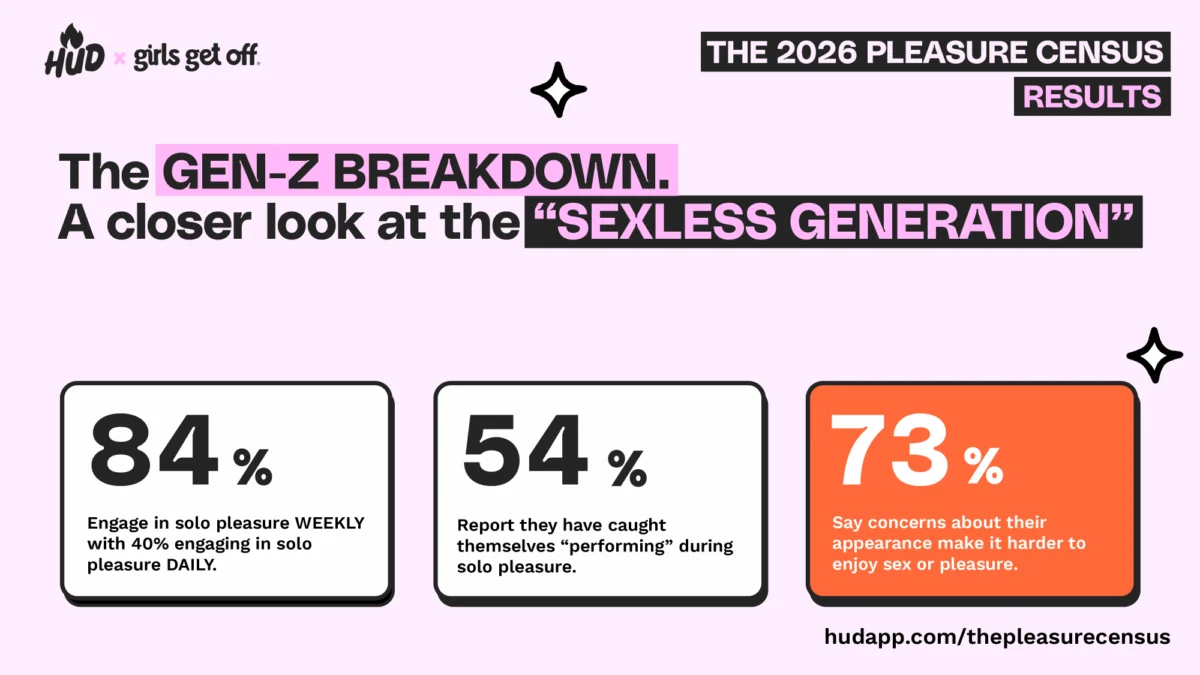
The most striking takeaway is the disconnect between the desire for intimacy and the reality of the experience. Roughly 80 percent of all respondents expressed a clear desire to increase the frequency of their sexual encounters. Yet, this ambition is frequently stifled by an internal critic. Nearly half of all participants (44 percent) reported that concerns regarding their physical appearance directly inhibit their ability to enjoy sex or find pleasure. When the data is narrowed down to Generation Z, that figure climbs to a staggering 73 percent, effectively challenging the narrative that younger generations are merely "sexless" by choice or apathy. Rather, they appear to be paralyzed by a performance-based anxiety that turns intimate moments into self-conscious audits.
Chronology: From Silence to the "Spectator" Era
To understand the current climate, one must look at the evolution of sexual discourse—or the lack thereof. For decades, the path to sexual knowledge has been fractured.

- The Early Years (Formative Development): The census highlights a critical failure in upbringing. For 38 percent of respondents, sex was rarely discussed during their formative years. For another 35 percent, the topic was either handled with overt negativity or strictly ignored. Only a fraction—10 percent—reported having open, positive dialogues about their bodies and desires at home.
- The Educational Void: As these individuals entered adolescence, they found little solace in institutional settings. Formal sex education was cited as a primary source of information by a mere one percent of participants. This data aligns with the sobering reality that, in the United States, only 19 states mandate that sex education must be medically accurate.
- The Trial-and-Error Phase: With a vacuum of guidance, 60 percent of respondents reported that they learned about sex through "personal experience." This "learn-as-you-go" approach, while universal, has led to a landscape where sexual health and pleasure are largely self-taught, often reinforced by unreliable or pornographic online content (17 percent).
- The Current "Spectatoring" Crisis: This historical context has culminated in the phenomenon of "spectatoring." According to the survey, 70 percent of all respondents admit to "performing" during solo pleasure—watching themselves from a third-party perspective rather than immersing themselves in physical sensation. Among Gen Z, 54 percent engage in this behavior, which serves as a psychological distancing mechanism that carries over into partner-based intimacy.
Supporting Data: The Breakdown of Performance Anxiety
The Pleasure Census does not just identify problems; it maps them with surgical precision. The data reveals that the "performance" mentality is not limited to the bedroom with a partner; it has infiltrated the most private of spaces.
One of the most revealing statistics is that 84 percent of Gen Z participants engage in solo pleasure at least once a week, with 40 percent doing so daily. Despite this high frequency of self-exploration, the inability to disconnect from the "inner critic" remains pervasive. The census highlights that when an individual is constantly assessing their body image or the "look" of their performance, they effectively shift their brain out of the parasympathetic nervous system—the "rest and digest" state necessary for arousal—and into a state of hyper-vigilance.
Furthermore, the "Orgasm Gap" is increasingly being re-characterized as a "Communication Gap." With 50 percent of participants admitting they are only "somewhat comfortable" telling a partner what they actually want, it is clear that the lack of foundational vocabulary regarding pleasure is a major structural issue. The inability to articulate needs, combined with the pressure to perform to an imagined standard, creates a feedback loop of dissatisfaction.
Official Responses and Expert Perspectives
While the creators of the survey—HUD and Girls Get Off—have framed the findings as a call to action for better sexual literacy, psychologists and sex educators are using the data to push back against the "sexless generation" label.

"We are seeing a generation that is being unfairly judged by their declining statistics in hookups," says one researcher associated with the study. "If you look at the census, they aren’t ‘sexless’ because they don’t want sex. They are struggling because they have been deprived of the tools to navigate it without shame."
Critics of current educational standards point to the "one percent" figure regarding formal sex education as a systemic failure. By leaving the burden of education to personal experimentation and the internet, society has effectively ensured that sexual anxiety remains the default setting. The consensus among the experts is that unless sex education moves beyond the binary of "abstinence vs. disease prevention" and begins to cover the mechanics of pleasure, consent, and body neutrality, the anxiety levels identified in the census will only continue to climb.
Implications: Where Do We Go From Here?
The implications of the Pleasure Census are both profound and actionable. If we accept that pleasure is currently "self-taught," then the primary intervention must be the normalization of sexual discourse.
The Shift to Body Neutrality
The data suggests that the focus on "body positivity" may be insufficient for those struggling with performance anxiety. Instead, the move toward "body neutrality"—the idea that one’s body is a vessel for experience rather than a performance piece—is essential. By decoupling physical appearance from sexual worth, individuals may be better able to combat the spectatoring effect.

Bridging the Communication Gap
The fact that half of all respondents feel uncomfortable communicating their desires to partners points to a need for a new "intimacy curriculum." This involves not just knowing how to say "no," but having the vocabulary to say "yes" to specific forms of pleasure. Apps and platforms like HUD are now looking at ways to integrate "pleasure-positive" prompts that encourage users to discuss preferences before meeting, potentially lowering the barrier to entry for honest communication.
Reclaiming the Solo Experience
The census highlights that solo pleasure is a high-frequency activity for the majority of the population. By reframing solo time as a space for mindfulness and sensory exploration—rather than a performance to be judged—individuals can break the habit of spectatoring. When one learns to feel pleasure in isolation without the gaze of an "audience," the ability to maintain that presence with a partner becomes significantly easier.
Ultimately, the Pleasure Census serves as a mirror to a generation caught between the desire for profound connection and the weight of digital-era expectations. It confirms that the path to a healthier sexual future is not found in more apps or more content, but in the radical act of honesty: honesty with ourselves about our insecurities, and honesty with our partners about our needs. As the study concludes, while this awareness cannot solve every hangup overnight, acknowledging the gap between our performance and our pleasure is the first, and most necessary, step toward closing it.
