

In an era where the average price of a new vehicle continues to hover at record-breaking heights—often exceeding $48,000—and the term "entry-level" has been effectively scrubbed from manufacturer brochures, the search for affordable, reliable transportation has become a scavenger hunt for the ghosts of the 1990s. As new cars become increasingly complex, laden with expensive sensor arrays and proprietary software, a counter-movement has emerged among automotive enthusiasts and budget-conscious commuters alike: the pursuit of "normcore" simplicity.
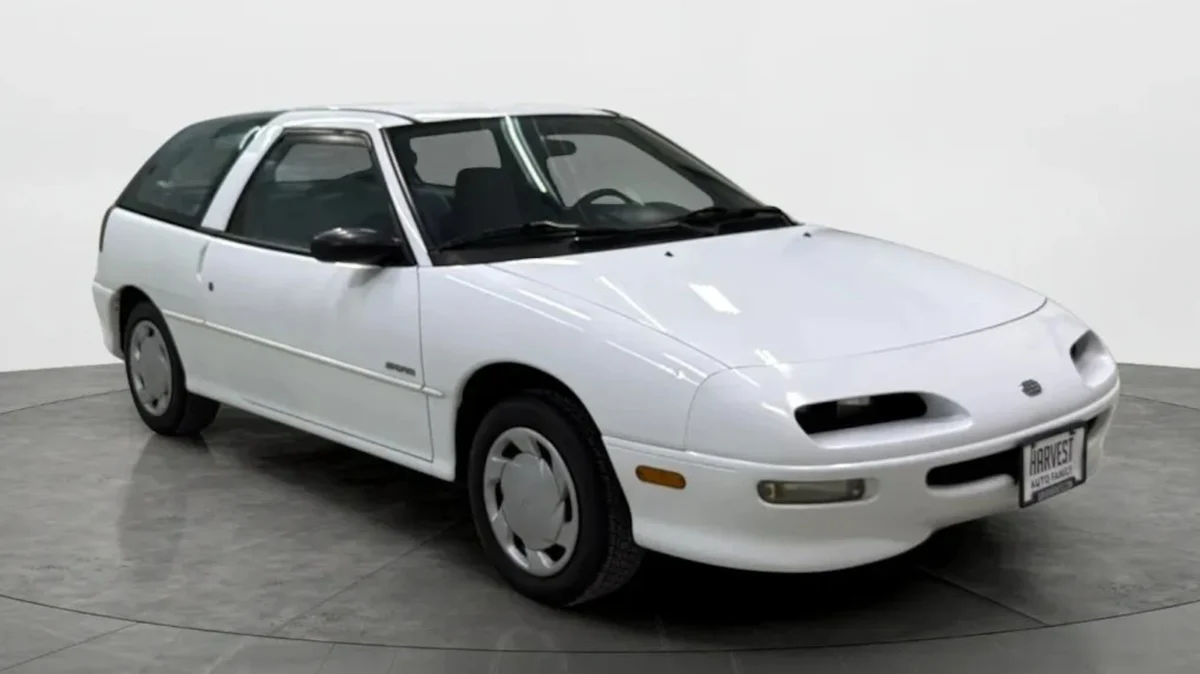
Enter the 1992 Geo Storm Shooting Brake, a survivor of an era when General Motors still experimented with niche styling and modest mechanical footprints. Currently listed at Harvest Auto Family in Wahoo, Nebraska, for $9,199, this vehicle represents more than just a 32-year-old hatchback with 74,463 miles on the clock; it represents a fading philosophy of motoring that once defined the American economy car.
The Epitome of Simple Motoring: A Mechanical Snapshot
The Geo Storm was never intended to be a supercar, yet it occupied a segment of the market—the compact sports coupe—that has been completely extinguished by the modern dominance of the crossover SUV. In the early 1990s, the Storm competed against the Nissan NX1600, the Hyundai Scoupe, the Toyota Paseo, and the Mazda MX-3. Today, there is no direct equivalent to these nimble, low-slung, and inherently honest vehicles.
Under the hood of this specific example lies a SOHC 1.6-liter four-cylinder engine. When it rolled off the assembly line, this powerplant produced a modest 95 horsepower and 97 pound-feet of torque. Paired with a three-speed automatic transmission and rolling on 14-inch steel wheels, this is not a car built for the drag strip. It is, however, a car built for efficiency and mechanical longevity.
The interior—a distinctive, period-accurate shade of blue—serves as a reminder of a time before the industry standardized on black and grey plastic interiors. While the listing remains coy about the functionality of the air conditioning system, the presence of the bright blue AC button on the dash offers a glimmer of hope for those residing in warmer climates. It even features a driver’s side airbag, a hallmark of the safety-conscious early 1990s, offering a modicum of security that makes this vintage machine surprisingly daily-drivable.
Chronology: The Rise, Fall, and Legacy of Geo
To understand why this Geo Storm is a cultural artifact, one must understand the context of the Geo brand itself. Launched in 1989, Geo was General Motors’ bold experiment in rebranding high-quality, small-displacement vehicles produced by its Japanese partners—primarily Isuzu, Suzuki, and Toyota—to compete with the influx of economical imports.
- 1989: The Geo brand is established. The Storm is introduced as a stylish, Isuzu-based coupe, intended to bridge the gap between the utilitarian Metro and the rugged Tracker.
- 1990–1992: The peak of the Storm’s popularity. The vehicle is lauded for its "shooting brake" styling, which offered more cargo versatility than its coupe competitors.
- 1993: The Geo brand begins to lose its distinct identity as GM internalizes more of its small-car production.
- 1997: The final year for Geo. The brand is folded into the Chevrolet marque, and vehicles like the Prizm and Tracker are rebadged as Chevrolets.
- 2024–2026: A renaissance of interest. "Radwood-era" cars (vehicles from the 80s and 90s) see a massive surge in valuation as enthusiasts seek the analog driving experience.
The Storm’s lifespan was short, lasting only eight years, which has paradoxically increased its desirability today. It is a time capsule of a specific aesthetic—a "nineties-core" masterpiece that stands in stark contrast to the bloated, digital-first vehicles of the 2020s.
Supporting Data: The Cost of Modern Complexity
The appeal of this $9,199 Geo Storm is not merely nostalgic; it is mathematical. As repair costs for modern vehicles continue to climb—driven by the need for specialized diagnostic tools, proprietary computer modules, and advanced driver-assistance systems (ADAS)—the total cost of ownership for a new car has become a significant financial burden.
Recent data indicates that the average cost of an auto repair bill has increased by nearly 30% over the last five years. Furthermore, with the starting price of the cheapest new vehicles in the United States effectively anchored above the $20,000 threshold, the "bottom of the market" has shifted drastically.
For a consumer, purchasing a car like this Geo Storm offers several key financial advantages:
- Lower Depreciation: Unlike a new car that loses 20% of its value the moment it leaves the lot, this Storm has already hit the floor of its depreciation curve. It is a stable asset.
- Repairability: The 1.6-liter engine is a simple, mechanical unit. Most of the maintenance can be performed in a home garage with standard hand tools, bypassing the need for dealership labor rates that often exceed $150 per hour.
- Insurance: Premiums for a vehicle of this age are generally nominal, focusing primarily on liability rather than the high-cost collision coverage required for modern, sensor-heavy vehicles.
Industry Perspectives and Expert Analysis
Market analysts have noted a distinct trend: as the "normcore" car movement gains momentum, dealerships and private sellers are beginning to capitalize on the scarcity of clean, low-mileage examples of everyday vehicles.
"We are seeing a shift in the collector market," says automotive historian and analyst Marcus Thorne. "It isn’t just about Ferraris and Porsches anymore. People are looking for the cars their parents drove. They want the reliability of an era before over-engineering became the standard. The Geo Storm, in particular, represents a ‘missing link’ in automotive history. It’s rare, it’s distinct, and it’s finally getting the respect it deserves."
However, not all industry insiders agree that these prices are sustainable. Some argue that the $9,000 price point for a Geo Storm is a temporary bubble driven by social media trends and the "Radwood" effect—the car show circuit dedicated to 80s and 90s vehicles. "While the car is undeniably clean, it is still a three-speed automatic from 1992," notes dealer consultant Sarah Jenkins. "The buyer isn’t paying for the performance; they are paying for the preservation. The question is whether that premium holds once the current trend passes."
Implications: The Future of Affordable Motoring
The listing of this 1992 Geo Storm in Wahoo, Nebraska, serves as a litmus test for the automotive market. If a dealership can move a 32-year-old compact car at this price point, it signals a significant shift in consumer sentiment. It suggests that buyers are willing to sacrifice Bluetooth connectivity, backup cameras, and heated seats for the sake of mechanical simplicity and a unique aesthetic.
This vehicle is not for everyone. It is for the person who values the tactile click of an analog switch over the haptic feedback of a touchscreen. It is for the driver who enjoys being the only person at the stoplight in a "shooting brake" that looks like it drove straight out of a 1992 television commercial.
Ultimately, the Geo Storm represents a forgotten path. As the automotive industry pushes toward an all-electric, highly digitized future, the appeal of a simple, gas-powered, lightweight hatchback becomes more pronounced. Whomever purchases this vehicle will not just be buying a car; they will be buying a ticket to a bygone era of motoring—one that is, for the time being, still surprisingly affordable. Whether it ends up as a daily commuter in a small town or a star attraction at the next Radwood event, this Geo Storm stands as a defiant monument to the idea that sometimes, less really is more.
