

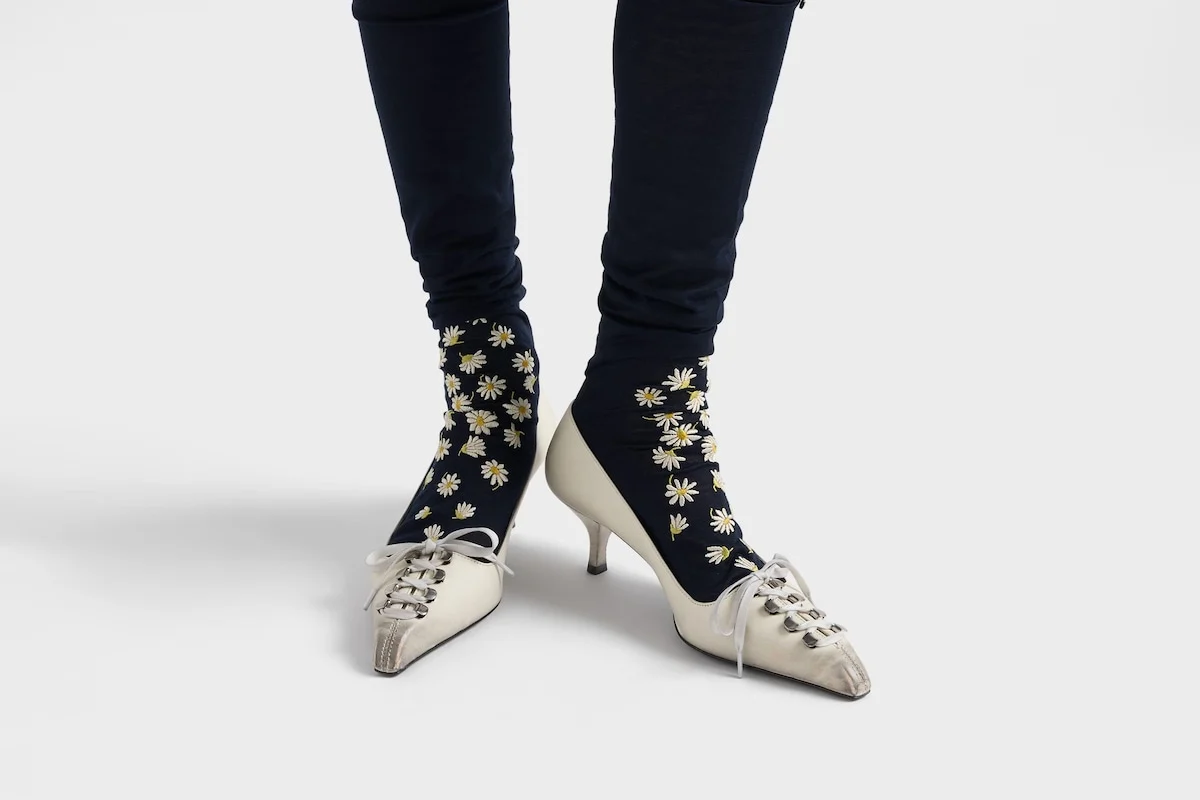
In the ever-evolving theater of high fashion, where the avant-garde often dances on the precipice of historical revivalism, Prada remains a master of the intellectual pivot. The Italian powerhouse, under the joint creative direction of Miuccia Prada and Raf Simons, has recently unveiled a piece that serves as a microcosm for their broader design philosophy: a pair of embroidered over-the-knee cotton socks that bridge the gap between Alpine tradition, 18th-century court vanity, and the modern desire for tactile, human-centric design.
While a pair of socks might seem like a modest addition to a global luxury house’s repertoire, they represent a significant stylistic statement. By blending the rustic charm of Tyrolean folk attire with the refined silhouettes of aristocratic history, Prada is not merely selling hosiery; they are curating a cultural dialogue.
The Main Facts: A Study in Craft and Context
The garment in question—a cotton-blend over-the-knee sock—is defined by its intricate embroidery and a distinctive drawstring closure. This aesthetic choice is deliberate, evoking a sense of "crafted luxury" that contrasts sharply with the sleek, synthetic uniformity of modern tech-dominated fashion.
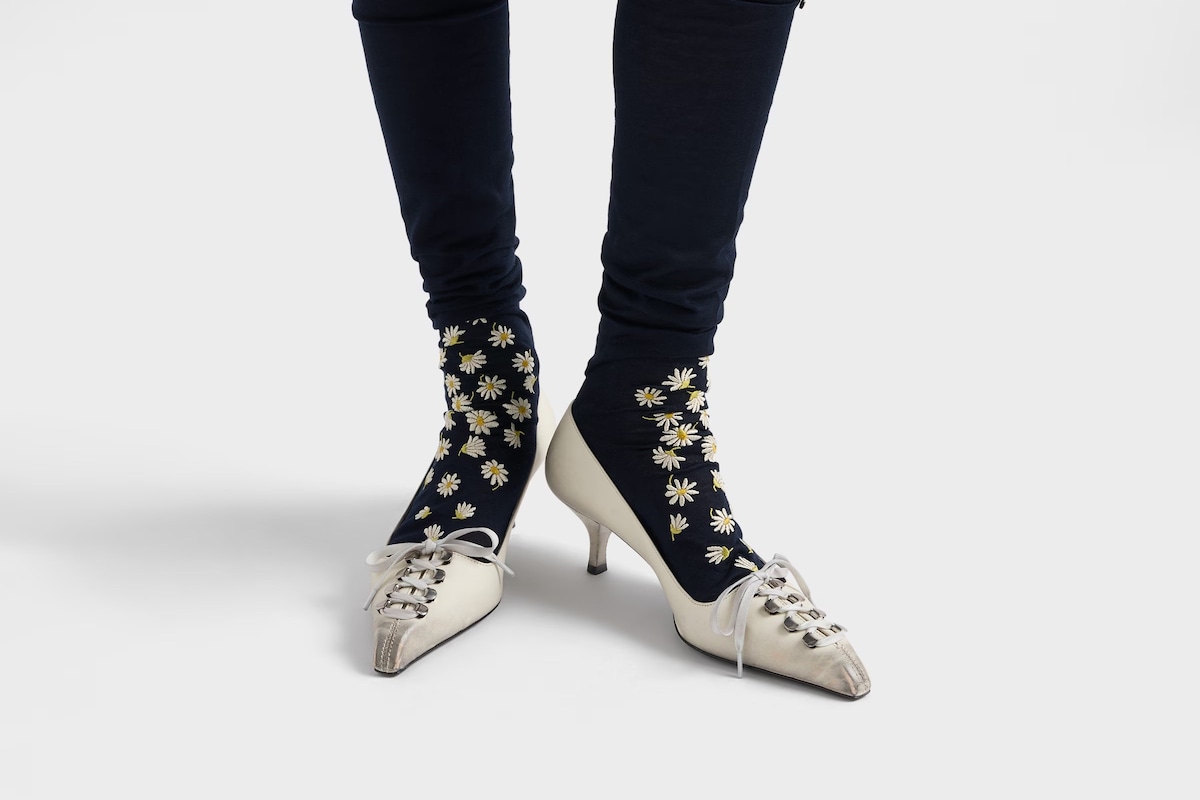
The design features delicate floral motifs that oscillate between the humble lawn daisy and the symbolic edelweiss—the latter being a hallmark of the Tyrolean region. The functionality of the drawstring at the top is the piece’s most "active" feature, allowing for a ruched, gathered look that creates a deliberate silhouette on the leg.
These socks are not merely accessories; they are a manifestation of the "human-made" aesthetic that Miuccia Prada has championed, particularly as the industry grapples with the encroaching influence of artificial intelligence. In a world where digital perfection is the baseline, the slight imperfection of hand-stitched embroidery offers a necessary antidote.
Chronology: The Evolution of the Alpine Aesthetic at Prada
To understand the current obsession with these socks, one must trace Miuccia Prada’s lifelong fascination with the Alpine landscape.
- The Early Years: Miuccia Prada’s childhood spent vacationing in the Alps laid the foundation for her recurring interest in the dirndl—the traditional dress of the Alpine region. Unlike many designers who view folk costume as kitsch, Prada has consistently treated it as a serious architectural form.
- The 20th-Century Shift: Throughout the 1990s and early 2000s, Prada frequently injected elements of traditional craft into her collections, often clashing them with industrial nylon or minimalist silhouettes.
- The Simons Era (2020–Present): The partnership with Raf Simons has intensified the intellectual rigor behind these choices. The Spring/Summer 2025 "anti-algorithm" collection, which explicitly challenged the homogenization of style, set the stage for pieces that emphasize individualistic, almost eccentric details.
- August 2026: The release of the embroidered over-the-knee socks marks a refinement of this ongoing narrative, positioning traditional craft as a form of contemporary rebellion.
Supporting Data: Why "Folk" is the New Luxury
The resurgence of folk-inspired design is not happening in a vacuum. Market data from luxury retail analytics indicates a growing consumer shift toward "heritage-coded" garments.
The Psychology of Craft
Industry experts note that as the "creative economy" becomes increasingly digitized, consumers are experiencing a "tactile deficit." Sales of handmade or hand-finished luxury goods have seen an uptick of approximately 14% year-over-year. The Prada socks, by incorporating embroidery that mimics hand-stitched folk patterns, tap into this psychological need for authenticity.
Historical Parallels
The silhouette of the over-the-knee sock is inherently historical.
- The 18th Century: In the courts of Versailles, the "well-turned calf" was a masculine obsession. French aristocrats would pad their stockings to achieve a sculpted, athletic look.
- The 1920s: The flapper era saw the rise of the knotted, over-the-knee look, representing a shift toward youthful, rebellious femininity.
Prada’s design successfully synthesizes these two disparate eras: the masculine vanity of the 1700s and the liberated, kinetic energy of the 1920s.
Official Perspectives: The Prada Philosophy
While Prada rarely releases formal press releases for individual accessory items, the design team’s past public commentary provides insight into the "why" behind the "what."
In recent discussions surrounding their design process, the house has emphasized that "fashion is a language." By incorporating Tyrolean elements, they are speaking to the permanence of tradition. Miuccia Prada has often remarked that her goal is to "make the ugly beautiful" or the "common extraordinary." By elevating the peasant-style sock to the level of a luxury item, she is exercising her signature brand of subversion.
The integration of Raf Simons, known for his own deep roots in youth culture and subversion, has only amplified this. For Simons, the sock is a tool of styling—a way to ground a high-concept outfit in something relatable, grounded, and undeniably human.
Implications: Where Fashion Goes From Here
The success of these socks signals a broader transition in the fashion cycle. We are moving away from the era of "logomania" and toward an era of "curated idiosyncrasy."
1. The Anti-Algorithm Movement
The decision to focus on specific, highly textured, and culturally rich accessories is a direct challenge to the "algorithmic" way people shop online. When an item requires an understanding of history—the difference between a generic floral print and a specifically Tyrolean edelweiss—it becomes a marker of cultural capital.
2. The Return to the "Well-Turned Calf"
We are witnessing a return to leg-centric styling. As hemlines continue to fluctuate, the focus has moved to the lower limb as the primary canvas for expression. Prada’s socks suggest that the future of luxury lies in the details that sit just below the knee.
3. Sustainability and Longevity
In an era of fast fashion, a high-quality cotton sock is a sustainable investment. By emphasizing the craftsmanship of the embroidery, Prada encourages consumers to view the item as a collectible rather than a seasonal disposable. It promotes a "slow fashion" mindset that favors longevity over the rapid turnover of trends.
Conclusion: The Enduring Appeal of the Human Touch
When we analyze the Prada embroidered over-the-knee cotton socks, we aren’t just looking at fabric. We are looking at a complex, layered history of class, geography, and gender. We see the ghost of an 18th-century courtier, the rugged independence of an Alpine villager, and the calculated, intellectual wit of Miuccia Prada herself.
These socks are a reminder that even in the age of the algorithm, the most forceful fashion statements are those that feel human. They invite us to reconsider the beauty of a well-turned calf and the enduring power of a story told through thread. As fashion continues to navigate the tension between the digital future and the analog past, pieces like these will likely serve as the anchor, reminding us that no matter how much the industry changes, the human desire for art, history, and craft remains the ultimate constant.
For the modern shopper, the decision to purchase these socks is a decision to participate in this dialogue—to wear a piece of history that is, at once, deeply personal and globally significant. Whether paired with a sharp, minimalist suit or a flowing, folk-inspired skirt, they are a testament to the fact that style is not just about what you wear, but the weight of the history you choose to carry with you.
