

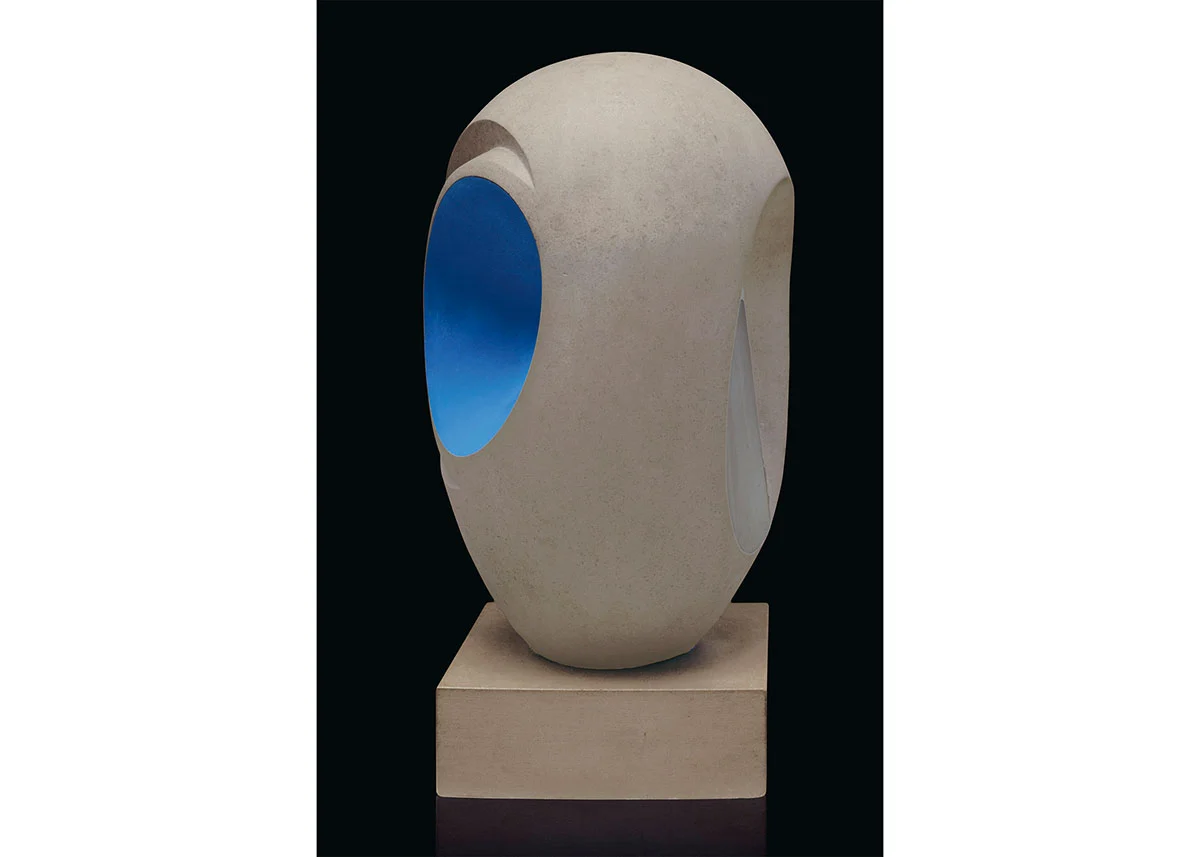
In the rarified world of modern British sculpture, few names carry the weight and visionary significance of Barbara Hepworth. On October 21, Christie’s London will offer collectors a rare opportunity to acquire a defining piece of 20th-century art history: Sculpture with Colour (Eos). This mid-career masterpiece, a seminal example of Hepworth’s exploration of form, light, and the interplay between stone and pigment, arrives at the evening sale with a presale estimate of £5 million to £8 million ($6.6 million to $10.5 million).
The auction marks a significant moment for the market, as Eos—a work that has been central to the narrative of British Modernism for nearly eight decades—returns to the spotlight.
The Anatomy of a Masterpiece: Form and Philosophy
Carved in 1946 from a singular, pristine block of Hopton Wood limestone, Sculpture with Colour (Eos) is a testament to the post-war creative energy that defined Hepworth’s practice. Standing at approximately two feet in height, the egg-shaped monolith is more than a mere object; it is an immersive experience.
The sculpture features three distinct, hollowed-out recesses. Each interior void is meticulously painted in pale gray, off-white, and a deep, resonant blue. These color choices were not arbitrary; they were deeply symbolic for the artist. According to a statement provided by Christie’s, the palette is intended to evoke “the depths of the ocean, the boundless sky and the infinite reaches of the cosmos.”
By introducing color to the interior of her stone carvings, Hepworth challenged the traditional, monochromatic expectations of sculpture. She transformed the negative space—the voids she so famously carved—into active participants in the work. The color draws the viewer’s eye inward, inviting a meditative contemplation of the relationship between the solid, earthly stone and the ephemeral concepts of space and light.
Chronology: A History of Provenance and Presence
1939–1946: The Cornish Crucible
The creation of Eos occurred during a pivotal era for Hepworth. Having moved to Carbis Bay in Cornwall with her family in 1939—just before the outbreak of World War II—Hepworth found the rugged, ancient landscape of the Cornish coast to be a profound influence. The isolation of the war years, combined with the proximity to the sea and the Neolithic standing stones of West Penwith, stripped her work of ornamentation, leaving only the essential.
1948–1949: The Lee Miller Lens
The cultural relevance of Eos was solidified in 1948, when it was captured by the legendary photographer Lee Miller. The black-and-white photograph, which appeared in the October 15, 1949, issue of American Vogue, offers a rare glimpse into the artist’s domestic and creative sanctuary.
In the frame, Hepworth sits composed, with a tea set in the foreground and a cat resting on a nearby sofa. Eos is perched on a table to the right, a testament to the sculpture’s status as a valued object within the artist’s personal sphere. This image, which serves as a vital historical document, connects the sculpture not just to the art gallery, but to the lived reality of a woman navigating the complexities of post-war success.
1962–2016: The Pincus Era and Beyond
The work’s provenance is as impressive as its aesthetic. It was acquired by the renowned American philanthropists David and Geraldine Pincus in 1962 from the Martha Jackson Gallery. The Pincus collection, famous for its blue-chip acquisitions, also notably included Mark Rothko’s Orange, Red, Yellow (1961), which achieved a record-breaking $86.9 million at auction in 2012.
Following the dissolution of the Pincus estate, Eos appeared at Christie’s in 2016. In a spectacular performance that underscored the rising demand for Hepworth’s work, it sold for $5.4 million, significantly exceeding its presale estimate of $1.2 million to $1.8 million.
Supporting Data: The Market for Barbara Hepworth
The trajectory of Eos mirrors the broader appreciation of Barbara Hepworth in the global art market. For decades, Hepworth was often overshadowed by her contemporary and former husband, Ben Nicholson, or her fellow sculptor Henry Moore. However, in recent years, the market has undergone a fundamental correction, recognizing Hepworth as the equal, and in some respects the superior, of her peers.
The institutional support for her work has been robust. Eos was a centerpiece of the “Hepworth in Colour” exhibition at the Courtauld Gallery in London this past summer, an exhibition that sought to reframe the artist’s relationship with pigment. Her inclusion in major retrospectives at the Tate and international museums has cemented her status as a titan of the modernist movement.
When considering the valuation of £5 million to £8 million, analysts point to the sculpture’s unique characteristics:
- The "Color" Factor: As one of the earliest works to incorporate painted interiors, Eos represents a technical innovation in Hepworth’s oeuvre.
- The "Egg" Form: This shape is quintessential to her practice, embodying fertility, potential, and the elemental nature of human existence.
- Historical Documentation: Its appearance in the Lee Miller Vogue spread provides an irrefutable provenance that adds layers of cultural value.
Official Responses and Curatorial Perspectives
Alice Murray, the Head of Modern British and Irish Art at Christie’s London, has been vocal about the significance of this sale. "Sculpture with Colour (Eos) has been at the heart of Hepworth’s story for 80 years," Murray noted. She emphasized that the work’s pedigree—having debuted in Hepworth’s first post-war solo show in 1946—makes it a foundational piece for any serious collection.
Curators who worked on the recent Courtauld exhibition echoed this sentiment, suggesting that Eos is not just a sculptural object but a primary text for understanding the evolution of 20th-century abstraction. By stripping away the representational, Hepworth allowed the stone to speak for itself, creating a dialogue between the viewer and the void.
Implications: The Legacy of a Visionary
The upcoming sale of Sculpture with Colour (Eos) carries significant implications for the contemporary art landscape. Firstly, it signals the continued strength of the Modern British market. Despite global economic uncertainties, works of high historical importance with clear provenance continue to perform exceptionally well.
Secondly, the sale reinforces the importance of the "female gaze" in modern sculpture. Hepworth’s ability to combine the industrial (the stone carving) with the organic (the color, the shape) offered a distinct alternative to the often more monumental, masculine approach of her contemporaries. Her work, and Eos specifically, acts as a bridge between the tradition of direct carving and the conceptual developments of the late 20th century.
As the gavel prepares to fall in London, the eyes of the art world will be fixed on this small, egg-shaped stone. Whether it remains in a private collection or moves to a public institution, Sculpture with Colour (Eos) has already achieved the ultimate goal of the artist: it has transcended its material origins to become an enduring symbol of the sky, the sea, and the infinite reaches of human creativity.
For the collector, this is more than an investment; it is the acquisition of a piece of history—a stone that, despite its solid nature, has carried the light and color of the cosmos for eighty years.
