

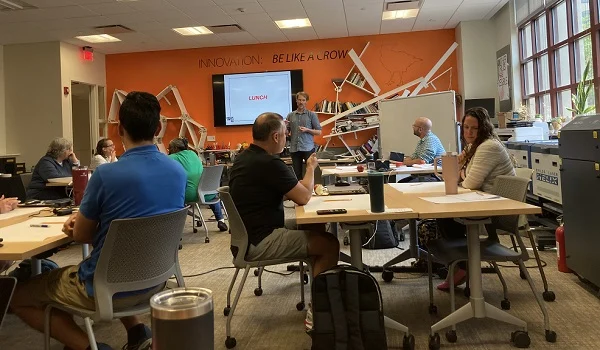
In an era where technological literacy is no longer an elective but a foundational requirement for the modern workforce, a transformative pedagogical movement is taking root in New Jersey. Throughout this past August, educators from across the state gathered at Montclair State University (MSU) for an intensive workshop aimed at mastering the intersection of 3D printing, digital design, and classroom innovation. Led by MSU professors Jason Frasca and Iain Kerr, the program serves as a cornerstone of a long-standing partnership between the university’s MIX Lab and the Picatinny Arsenal, a premier U.S. Army research and engineering facility based in Rockaway, New Jersey.
The initiative represents far more than a technical training course; it is a fundamental rethinking of how educators approach creativity, autonomy, and the manifestation of physical objects from digital concepts.
The Foundation: A Collaborative Vision for STEM and STEAM
The partnership between Picatinny Arsenal and the MIX Lab is built on a shared commitment to fostering the next generation of engineers, designers, and thinkers. Picatinny Arsenal, which has long championed STEM (science, technology, engineering, math) and STEAM (which incorporates the arts) initiatives, provides the funding and hardware necessary to bring these advanced capabilities into K-12 classrooms.
“Picatinny Arsenal supports STEM and STEAM education in New Jersey K-12 school systems by providing 3D printers and support for 3D printing and robotics teams in high schools,” explains Jason Frasca. “They engaged us many years ago to teach the teachers how to use their 3D printers.”
However, the scope of the collaboration has expanded significantly since its inception. While the initial goal was hardware literacy, the current mission is to empower teachers with the pedagogical frameworks necessary to teach 21st-century skills. By embedding themselves in the curriculum, these workshops ensure that 3D printing is not merely an auxiliary hobby for students, but a core component of a broader, agency-driven learning experience.
Chronology of the Workshop: From Analog Ideation to Digital Manifestation
The workshop structure is meticulously designed to break down the traditional barriers between conceptual thought and technical execution. The day began not with software manuals, but with physical, analog design exercises.
Under the guidance of Iain Kerr, teachers were encouraged to use their entire bodies to engage in "big thinking." This process involves bridging the gap between analog sketches and digital CAD (computer-aided design) software. Kerr’s approach focuses on building "muscle memory" by connecting geometric shapes—rectangles, circles, and lines—that exist in both the physical world and the digital workspace.
The 25-Minute Threshold
A significant departure from traditional design instruction is the speed at which participants move to production. Frasca notes that many CAD courses fail because they spend months introducing every tool in the software suite before allowing students to create a tangible object.
“Our approach is to, within 25 minutes, get everybody actually creating something that they could 3D-print,” Frasca says. By starting with a simple cube and demonstrating how it can be manipulated into a sphere—and subsequently, virtually any object—the instructors demystify the technology. This rapid-prototyping mindset ensures that educators see immediate results, which they can then replicate in their own classrooms to keep student engagement high.
Pedagogical Philosophy: Autonomy and Agency
The core of the MSU-Picatinny workshop is the cultivation of "autonomy and agency." The instructors do not merely teach software; they model a teaching style that prioritizes student independence.
Finding the Path: Independent Discovery
During the afternoon sessions, Kerr emphasized that students should not be spoon-fed instructions. Instead, they should be encouraged to explore the software, experiment with different "lofts" and modifiers, and manage their own digital workspaces.
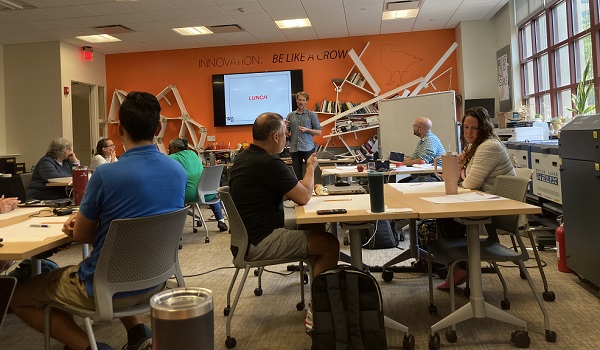
“There is not one right way to create a design, but multiple ways,” Kerr told the attendees. By encouraging students to keep multiple tools and tabs open, teachers allow them to jump between different workflows. This fluidity is essential for creative problem-solving, as it allows students to iterate quickly and pivot when a design challenge presents itself.
The Gallery Walk
One of the most effective pedagogical tools highlighted in the workshop is the "gallery walk." By turning the classroom into a temporary exhibition space, teachers allow students to circulate, examine their peers’ work, and engage in constructive dialogue. This peer-to-peer learning model serves two purposes: it exposes students to a variety of techniques they might not have considered, and it builds a community of practice where the sharing of ideas is as valued as the final product.
Moving Beyond Ideation: The Framework of Novelty
One of the most profound insights shared by Frasca during the workshop concerns the limitations of traditional "brainstorming."
“We can only ideate what we know, what you’ve already seen and been exposed to, heard or engaged with,” Frasca explains. “And therefore, we can never ideate anything novel or unique. Novelty requires approaches and tools and frameworks to actually get to some different, innovative place.”
The workshop teaches educators how to move past the "ideation trap" by using design software as a generative tool. By learning how to manipulate geometric frameworks, students and teachers alike can design beyond what they initially imagine. This shift from "designing what you know" to "designing through the software" is the essence of true innovation. It allows students to explore forms and structures that are not bounded by their prior experiences, effectively expanding their cognitive and creative horizons.
Supporting Data and The Future of STEAM in NJ
The success of these workshops is visible in the enthusiasm of the participating teachers. The ability to visualize a concept and hold the physical manifestation of that concept within a single school day is a powerful catalyst for change.
The implications for New Jersey schools are profound. By equipping teachers with the ability to integrate CAD and 3D printing into their daily lesson plans, the partnership ensures that:
- Curriculum is future-proofed: Students are learning tools that are currently used in advanced manufacturing and engineering.
- Creativity is standardized: Innovation is no longer treated as a "lucky break," but as a systematic process that can be taught.
- Agency is prioritized: Students move from being passive consumers of technology to active creators and designers.
As the state continues to push for higher standards in technology education, the model established by the MIX Lab and Picatinny Arsenal serves as a blueprint. It highlights that the most effective way to teach technology is to focus on the human element: the capacity for the teacher to model curiosity, the ability for the student to exercise agency, and the willingness of both to embrace the iterative, often messy, process of creation.
Conclusion: Empowering the Next Generation
The workshop at Montclair State University serves as a reminder that the tools of the future are not just for the elite or the technically gifted. They are for the classroom. Through the tireless efforts of professors like Jason Frasca and Iain Kerr, and the sustained support of institutions like the Picatinny Arsenal, New Jersey educators are being given the keys to a new educational paradigm.
By fostering an environment where teachers can explore, fail, succeed, and share, the MIX Lab is effectively building a network of innovators across the state. These teachers are returning to their schools not just with 3D printers, but with a new philosophy—one where digital design is a bridge to the limitless potential of the student mind. As these educators implement these frameworks, the impact will be felt in the designs of tomorrow, the innovations of the next decade, and the agency of the next generation.
About the Author: Esther Surden is the Founder and Editor in Chief of NJ Tech Weekly, a publication dedicated to tracking the growth and development of the technology ecosystem in New Jersey.
