

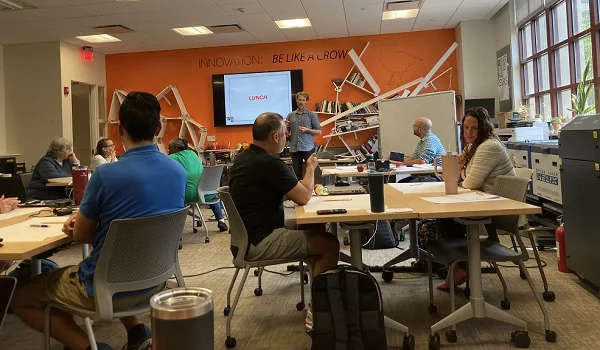
In the landscape of modern education, the gap between theoretical knowledge and practical application is often where innovation goes to wither. However, inside the halls of Montclair State University (MSU) this past August, a transformative initiative was underway. Professors Jason Frasca and Iain Kerr, the architects behind the university’s renowned MIX Lab, hosted a specialized 3D printing and innovation workshop designed not just to teach educators how to operate hardware, but to fundamentally shift the pedagogical approach to STEM (science, technology, engineering, math) and STEAM (science, technology, engineering, arts, math) in New Jersey’s K-12 classrooms.
Supported by the Picatinny Arsenal—a U.S. Army research facility located in Rockaway, New Jersey—the workshop serves as a critical bridge between military-grade technical prowess and the foundational development of the next generation of American innovators. By funding the attendance of K-12 educators, the Arsenal is investing in a ripple effect: one teacher trained in the MIX Lab philosophy can impact hundreds of students over the course of a career.
The Objective: Empowering Educators as Innovators
The mission of the workshop was multifaceted. Beyond the mechanical operation of 3D printers, the curriculum focused on three core pillars: digital-design software proficiency, classroom pedagogical strategies, and the cultivation of an "innovation mindset."
For many educators, the prospect of integrating CAD (computer-aided design) software into a classroom is daunting. The industry standard often involves a tedious, months-long curriculum of memorizing every tool icon before a student is permitted to create a single physical object. Frasca and Kerr, however, have pioneered a "fast-track" approach. By prioritizing creative agency and autonomy, they allow teachers to produce a 3D-printable object within the first 25 minutes of instruction.
"The workshop is designed to model autonomy and agency with the teachers, so they can bring this powerful approach to teaching into their classrooms," Frasca explained during the session. The ultimate goal is to move students from being passive consumers of technology to becoming creators, designers, and problem-solvers who feel a sense of ownership over their digital and physical creations.
A Chronology of the Workshop: From Analog to Digital
The day-long immersion was structured to dismantle the traditional, often rigid barriers between human cognition and software-driven design.
Morning Session: The Analog-Digital Bridge
The session opened with Professor Iain Kerr leading the group through rudimentary design exercises that required teachers to use their entire bodies. By stepping away from the keyboard and focusing on physical movement and traditional drawing, participants were encouraged to think expansively.
"Bridging the gap between the analog and the digital allows people to ground themselves in what they’re trying to create and design," Frasca noted. By connecting basic geometric shapes—the fundamental building blocks of both the physical world and CAD software—teachers began to develop a form of "muscle memory." This tactile foundation ensures that when they eventually move to the screen, they are not merely clicking buttons, but translating a physical concept into a digital reality.
Mid-Day Session: The Power of Iteration
By midday, the focus shifted to the software itself. The instructors moved away from the "six-month tool-memorization" model, opting instead for a methodology that treats software as an extension of the creative process. Teachers learned that a simple cube can be manipulated into a sphere, which in turn can be modified into virtually anything. This lesson in versatility is crucial for students: it teaches them that a single tool or object has infinite potential if one possesses the right framework of thinking.
Afternoon Session: Independent Inquiry and Collaborative Learning
As the day progressed, Kerr shifted the focus toward independence. He emphasized that students should not be spoon-fed instructions, but rather taught how to navigate the software ecosystem themselves. He encouraged the use of features like "loft"—a sophisticated design command—and stressed that students should keep multiple tools and tabs open simultaneously.
"There is not one right way to create a design, but multiple ways," Kerr told the attendees. This philosophy of "multiple pathways" is a cornerstone of 21st-century skill-building, moving students away from the binary "right or wrong" answers of traditional schooling and into the realm of design-thinking.
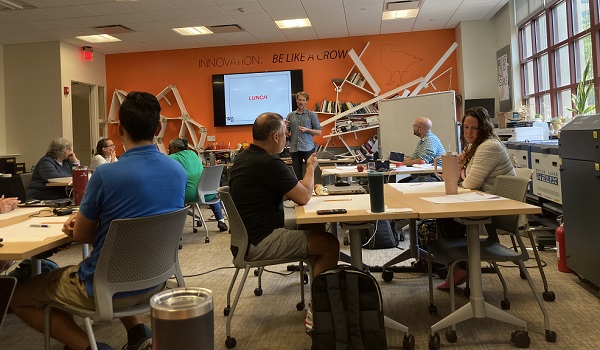
The day concluded with a "gallery walk," where participants toured the room to view each other’s creations. This exercise is designed to be taken back to the classroom, fostering an environment of peer-to-peer feedback and technical sharing.
Supporting Data and Collaborative Synergy
The collaboration between Picatinny Arsenal and the MIX Lab is not a recent development, but rather the fruition of a long-standing partnership. The Arsenal has been a consistent champion of New Jersey’s K-12 systems, providing the physical hardware—3D printers—and support for robotics teams across the state.
"They engaged us many years ago to teach the teachers how to use their 3D printers," Frasca noted. Since then, the partnership has evolved. It is no longer just about the machinery; it is about the methodology.
The data, while qualitative in this setting, is evidenced by the visible enthusiasm of the participants. Teachers who arrived in the morning with little to no experience in CAD software were, by the afternoon, drafting complex concepts that they previously would have deemed impossible. The synergy here is clear: the Army provides the resources and the institutional commitment, while MSU provides the pedagogical framework to ensure those resources are utilized to their maximum potential.
Official Perspectives: The Philosophy of Novelty
When asked about the role of ideation in the classroom, Frasca offered a profound critique of standard creative education. He argued that traditional paths toward innovation often rely on "ideation," but that true novelty is impossible if one only draws from existing knowledge.
"We can only ideate what we know, what you’ve already seen and been exposed to," Frasca explained. "Novelty requires approaches and tools and frameworks to actually get to some different, innovative place."
This is why the MIX Lab emphasizes frameworks within the software. By providing these structured, yet open-ended design environments, teachers can guide their students to create things that go beyond what they can currently imagine. It is a process of "designing beyond the imagination," where the software acts as a catalyst for new thoughts rather than a limiting box.
The Broader Implications for STEM/STEAM
The implications of this workshop extend far beyond the walls of the classroom. In an economy increasingly driven by additive manufacturing and rapid prototyping, these students are gaining the "muscle memory" required for the careers of the future.
Autonomy as a Pedagogical Goal
By fostering autonomy and agency, the MIX Lab model prepares students to thrive in ambiguous, high-tech environments. When a student learns that they can jump between multiple software tools and that there is "no one right way" to solve a design challenge, they develop the resilience required for engineering and artistic fields.
The Shift from Consumer to Creator
Perhaps the most significant takeaway from the workshop is the psychological shift in the student. In a world where youth are largely consumers of digital content, this training empowers them to be the architects of that content. Whether they are designing parts for a robot or sculptural art, they are learning that they have the power to manifest their ideas into the physical world.
A Model for Future Partnerships
The MSU and Picatinny Arsenal collaboration serves as a replicable model for other regions. By linking high-level research institutions with local school systems, states can ensure that the next generation is not only literate in STEM subjects but fluent in the language of innovation.
As the workshop concluded, the energy in the room was palpable. Teachers were not just leaving with a new technical skill; they were leaving with a new pedagogical toolkit. They were equipped to return to their schools and challenge their students to stop following instructions and start building the future.
In the words of the MIX Lab philosophy: the goal is not to produce students who can use a printer; it is to produce thinkers who can see the world, understand its geometry, and manifest their own unique visions within it. This is the true essence of STEAM education, and it is happening right now in New Jersey.
