

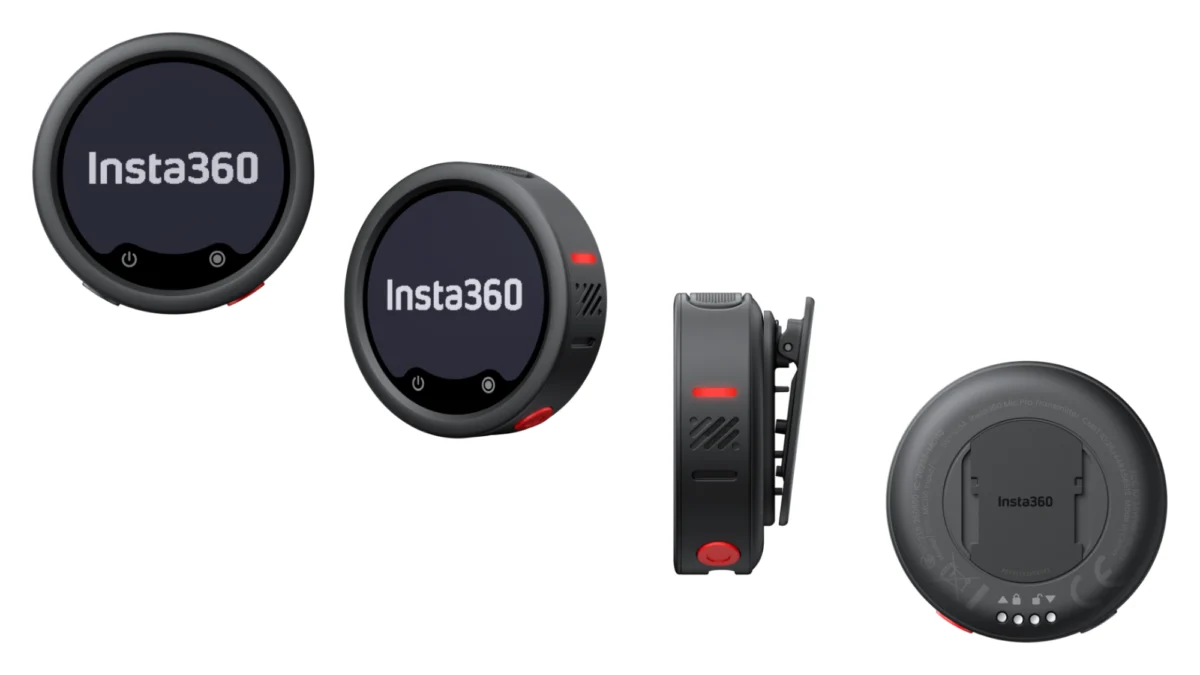
In the crowded landscape of content creation, where lapel microphones have become as essential as a high-quality lens, hardware manufacturers have historically focused on one singular goal: invisibility. For years, the industry trend has been to shrink transmitters to the point of being unobtrusive, ensuring they hide away under collars or blend into the fabric of a shirt. However, Insta360, a company known for disrupting the action camera market, has decided to pivot in the opposite direction. With the launch of the Insta360 Mic Pro, the company is arguing that if you cannot hide the microphone, you should make it a canvas.
The Mic Pro introduces a daring design choice—a customizable E-Ink display on the face of the transmitter—effectively transforming a utilitarian piece of audio equipment into a personalized fashion statement or a branding tool for creators.
The Shift in Philosophy: From Invisibility to Identity
For years, content creators have wrestled with the aesthetic dilemma of the lapel mic. Whether it is a vlog, a street interview, or a professional documentary, the black box clipped to a subject’s clothing is often an eyesore. While competitors like DJI have attempted to address this with swappable magnetic covers for their Mic Mini 2, these solutions have remained limited by color palettes and, inevitably, the persistent visibility of the manufacturer’s branding.
Insta360’s approach is fundamentally different. By integrating an E-Ink screen, the Mic Pro allows the user to completely erase the corporate branding and replace it with bespoke graphics, logos, or personal imagery. This move signals a shift in how audio gear is perceived—no longer just a tool for the production, but a piece of the creator’s personal brand identity.

A Technical Breakdown: What Lies Beneath the Screen
While the E-Ink display is the headline feature, the Mic Pro is a robust piece of audio engineering. Weighing in at 19.7 grams (without the attachment clip), it is admittedly heavier than its predecessor, the Mic Air. This increase in mass is a byproduct of the added screen hardware and the inclusion of significant internal storage.
Internal Recording and Audio Quality
The Mic Pro mirrors the industry standard for professional-grade field recording by offering 32GB of onboard memory. Crucially, it supports 32-bit float internal recording. For those unfamiliar with audio engineering, 32-bit float is a game-changer; it virtually eliminates the risk of clipping (digital distortion) even if the audio levels spike unexpectedly during a recording. It provides a level of dynamic range that allows creators to recover clean audio from what would otherwise be a ruined take.
Furthermore, the device records at a 48kHz sampling frequency, providing the fidelity required for high-end production. Insta360 claims the device can capture up to 22.2 hours of 32-bit stereo audio or 60 hours of 24-bit mono, ensuring that creators on long-form shoots rarely have to worry about running out of space or losing data.
Connectivity and Battery
One of the most requested features in the audio market—and one notably missing from some recent competitor releases—is the inclusion of USB-C ports directly on the transmitter. Insta360 has included this, allowing users to offload files or charge the device directly without relying on the charging case.

Battery performance is a critical factor for field production. The Mic Pro delivers up to 10 hours of continuous operation on a single charge. For those needing extended sessions, the newly designed fast-charging storage case acts as a power bank, allowing the transmitters to top up during breaks.
The Mechanics of Customization: How the E-Ink Display Works
The integration of the E-Ink screen is surprisingly intuitive, reflecting Insta360’s history of user-friendly app development.
- Pairing and Synchronization: Users connect the transmitter to the Insta360 mobile app via Bluetooth. The app interface acts as the control hub, displaying real-time information such as battery levels, signal strength, and current storage capacity.
- Asset Selection: Through the "Custom Wallpaper" menu, users can select from preloaded designs or upload custom images from their smartphone’s gallery.
- Refinement: The app offers a robust editing suite that allows users to crop, rotate, and zoom into their image to ensure the composition fits the small, rectangular screen perfectly.
- Display Modes: Users can choose between a detailed, slightly dithered rendition of their image or a simplified "blocked" filter designed for crisp logos and high-contrast symbols.
- Finalizing: Once the image is pushed to the device, the screen undergoes a rapid refresh (flashing black and yellow to clear ghosting) before the new design is locked in. Because it is an E-Ink display, the image remains etched on the screen even when the device is powered down, consuming zero battery while idle.
Chronology of the Market Evolution
To understand the significance of the Mic Pro, one must look at the trajectory of the wireless microphone market over the last decade:
- 2019-2021: The "Form Factor Wars." Companies like RØDE and DJI dominated by miniaturizing the wireless receiver and transmitter. The goal was to make them as small as a postage stamp.
- 2022-2023: The "Onboard Recording Era." As professional creators demanded more security against signal interference, manufacturers began baking internal storage into the transmitters, allowing them to function as independent field recorders.
- 2024: The "Identity and Integration Era." With the market saturated by functional, high-quality audio devices, differentiation is no longer about size or bit-depth alone. Insta360’s Mic Pro represents the start of a trend where hardware becomes an extension of the creator’s visual aesthetic.
Implications for Content Creation
The introduction of the Mic Pro has broader implications for the industry. First, it addresses the "logo fatigue" that many creators experience. When shooting sponsored content or professional interviews, having a prominent manufacturer logo on a piece of gear can sometimes clash with the visual tone of the video or the brand identity of the client. By allowing for a "blank slate," Insta360 is effectively offering a more professional, polished look.

Second, the use of E-Ink is a masterstroke of efficiency. Unlike OLED or LCD screens, which would be prohibitively power-hungry, E-Ink only consumes energy when the image is changing. This allows the screen to serve as a persistent identifier—a "digital name tag"—without compromising the device’s 10-hour battery life.
However, the design is not without its detractors. The persistence of the power and record button icons on the exterior of the shell has been noted as a minor aesthetic annoyance. These markings are static and cannot be customized, which slightly disrupts the seamless look of a custom image. Furthermore, the weight (19.7 grams) is significant enough that the magnetic attachment is generally preferred over the clip, as the clip tends to sag on thinner garments.
Official Stance and Market Availability
Insta360 has positioned the Mic Pro as a premium offering in their ecosystem. The company emphasizes that while the tech is sophisticated, the barrier to entry remains low for those already familiar with their camera app ecosystem.
Pricing and Configurations:

- Single Transmitter: $99.99
- Transmitter + Receiver: $199.99
- Dual Transmitter + Receiver + Charging Case: $329.99
By offering these modular tiers, Insta360 is catering to both solo creators who need a simple setup and professional production teams who require multi-mic, case-charged workflows.
Conclusion
The Insta360 Mic Pro is a fascinating study in product design. It acknowledges that in the digital age, hardware is rarely just about the utility—it is about the image. While the audio quality, 32-bit float recording, and USB-C connectivity make it a competitive and highly capable tool for any serious videographer, it is the E-Ink display that truly sets it apart.
By turning the transmitter into a digital canvas, Insta360 has effectively gamified the hardware experience. Whether you are a vlogger looking to show off a personal logo, or a production team needing to color-code your microphones for quick identification on a chaotic set, the Mic Pro offers a level of agency that was previously impossible. As the line between professional production equipment and consumer lifestyle gear continues to blur, the Mic Pro stands as a bold, creative, and highly practical step into the future of audio hardware.
