

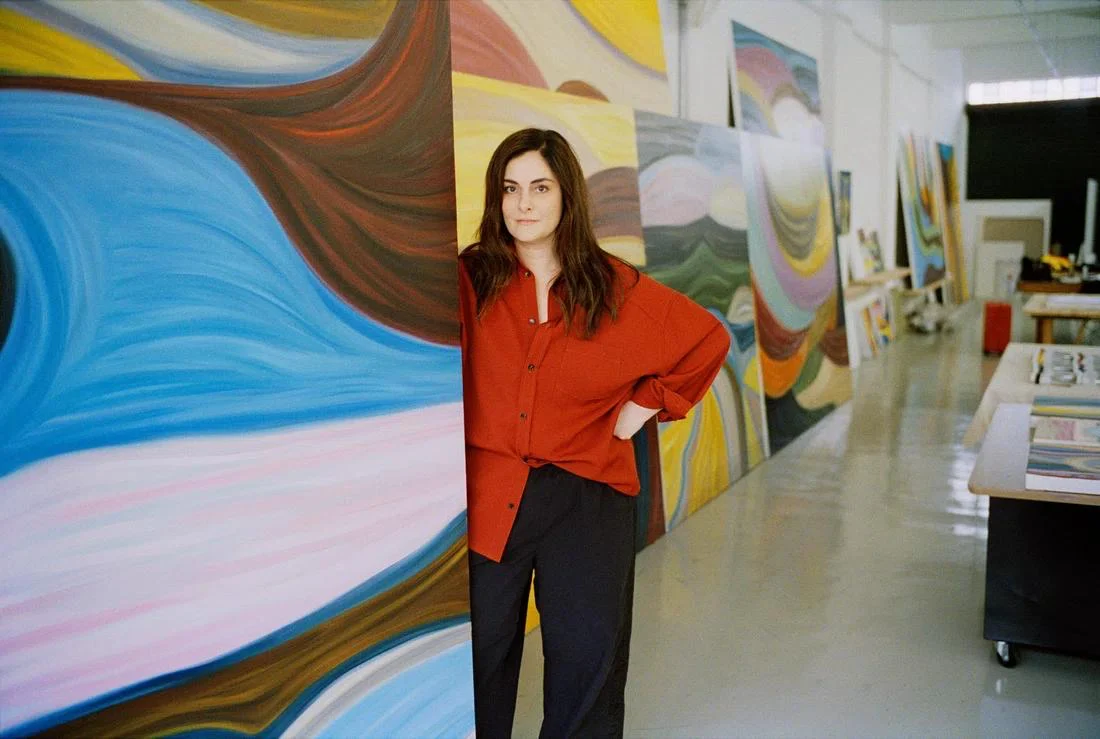
Amid the frantic, high-stakes ecosystem of Frieze London—where the air is thick with the clink of champagne flutes and the silent, high-pressure orchestration of multi-million-dollar deals—a pocket of profound silence has emerged. Within the Pace Gallery booth, Brazilian abstract painter Marina Perez Simão has constructed an installation that feels less like a commercial display and more like a vessel for extraterrestrial contemplation.
Simão, whose work has long navigated the liminal spaces between landscape and pure abstraction, has unveiled a series of 11 new canvases that reject the cacophony of the fair. Arranged in a deliberate, architectural "X" configuration, the booth demands a shift in the viewer’s pace, forcing a physical and sensory engagement that stands in stark contrast to the fleeting "swipe-and-scroll" culture of the contemporary art world.
The Geometry of Encounter: A Spatial Analysis
The installation is anchored by a precise, rhythmic distribution of color: three blue canvases, three gray, and five magenta. The "X" structure serves as both a barrier and a portal. By positioning two blue paintings on either side, a gray canvas at the heart of the intersection, and the remaining works flanking the outer edges, Simão has created a fluid flow of movement.
"The structure is super open and closed at the same time," Simão explains, speaking from her studio in São Paulo. "There is a sense of discovery that shifts entirely depending on which entry point the viewer chooses. It is meant to be a spaceship—a vessel that takes you somewhere else, even if you are standing in the middle of a trade show floor."
This architectural choice is intentional. Simão’s work has often been described as "vague descriptions of strange worlds," but at Frieze, she has moved beyond the canvas to dictate the viewer’s physical trajectory. By requiring guests to navigate the "X," she forces a deceleration, a necessary pause that allows the paintings to exert their own "nature and behaviors."

Chronology of a Shift: From ‘Solanaceae’ to the Present
To understand the gravity of these new works, one must look back at the trajectory of Simão’s recent practice. The current shift toward a restrained, colder palette began in 2024 with her exhibition Solanaceae at Pace in Los Angeles. Drawing inspiration from the botanical family of nightshades—plants known for their complex, often toxic, yet alluring biological properties—the works in that exhibition introduced a deliberate infusion of shadow and darkness.
The evolution continued later that year at the Mendes Wood DM gallery in Paris. In both instances, Simão began to peel back the layers of her usually vibrant, high-contrast style. "I’ve been thinking about working with a limited color range for a long time," she notes. "Color is the engine of my work, but I wanted to challenge myself to study the nuances of specific tonalities. I wanted to see what happened when I stopped reaching for the whole rainbow."
This year, as she prepared for Frieze, she took this restriction to its logical extreme. She removed every object from her studio that featured even a hint of color that didn’t align with her current palette. She retreated into a sensory-deprivation environment of her own making, painting by a window overlooking a terrace, working barefoot, and often sitting on the floor to engage physically with the surface of the linen.
The Science of Pigment: Magenta, Blue, and the Abstract Season
The selection of the three colors—magenta, blue, and gray—was not merely aesthetic; it was a conceptual exercise in temperature and behavior.
The Difficulty of Pink
Simão approached magenta with a healthy skepticism. "Pink is a treacherous color," she admits. "In our current era of mass-market, digital saturation, you immediately think of Barbie pink, bubblegum, or cotton candy. It’s an industrial, commercial color."

To avoid these connotations, she pivoted to a deep, resonant magenta. By manipulating the pigment, she found she could mimic the organic, elusive hues found in deep-tissue biology or the flora of alien landscapes. Unlike the mass-produced pinks of the digital age, her magenta feels rooted in the earth, albeit an earth viewed through a telescope.
The Inscrutable Nature of Blue
Blue proved to be the most taxing element of the series. Simão, known for her complex layering, found that blue pigments—specifically when using raw cobalt and cerulean—possess a stubbornness that resists the camera lens.
"The blue paintings are almost impossible to photograph," she says, noting that her team required three separate photo sessions just to capture the shifting reality of the pigments. "They possess a life of their own. They change based on the light in the room, the humidity, and the angle of the viewer." She often applied the pigment directly from the tube, allowing the inherent strength of the color to dominate, only occasionally softening it with a whisper of white to create a greenish, atmospheric shift.
The Gray Synthesis
The gray canvases function as the anchor of the installation, acting as a bridge between the "summer" heat of the blues and the "winter" chill of the magentas. Beneath the gray surface, Simão hides layers of yellow and ocher. When the light hits these canvases, they emit a faint, hazy glow—reminiscent of sunlight struggling to pierce through a thick, morning fog. Together, these paintings represent an "abstract season," a cycle of atmospheric conditions that exist outside of a calendar year.
The Physical Imperative: Why Texture Matters
A central theme of Simão’s commentary at Frieze is the loss of the "physical experience" of art. In an age where the majority of art consumption happens via Instagram grids and digital catalogs, the texture of oil on linen is often flattened into a two-dimensional image.

"It is fine to view images digitally, but we cannot forget that when you get close to a painting, there are layers, there are textures, there are mistakes," she asserts. This is precisely why she refuses to varnish her paintings. The matte, raw surface catches light and holds shadow, revealing the artist’s hand and the "imperfections" of the process. She wants the viewer to lean in, to see the weave of the linen, the buildup of the oil, and the slight inconsistencies in the application.
Implications for the Market and the Medium
The success of Simão’s booth at Frieze London serves as a case study for the evolving role of the gallery space. While the fair remains a venue for commerce, artists like Simão are successfully reclaiming the space as a venue for institutional-grade inquiry.
By demanding that the viewer inhabit the "spaceship" of her booth, she is resisting the "white cube" neutrality that characterizes most fair presentations. Her work suggests that abstract painting, rather than being an outdated medium, is one of the few tools left that can effectively capture the "complex and vast organism" of nature—a nature that, as she puts it, "we don’t fully understand."
As the crowds at Frieze continue to circulate, the blue, gray, and magenta canvases remain steadfast. They do not shout for attention; they vibrate with an internal logic. For those who take the time to step inside the "X," the experience is a reminder that art is not just something to be collected, but a way to approach the things that are, fundamentally, difficult to explain.
In her pursuit of these "strange worlds," Marina Perez Simão has not only expanded her own practice but has provided a necessary sanctuary within one of the world’s most chaotic art environments. Her work reminds us that even in a world obsessed with the new and the digital, the oldest form of human expression—applying pigment to a surface—remains the most potent way to map the mysteries of the universe.
