

Introduction: A Desert Time Capsule
In the heart of the Western Desert, approximately 225 miles southwest of the Giza Plateau, the Bahariya Oasis continues to serve as a profound repository of ancient Egyptian history. Egypt’s Ministry of Tourism and Antiquities recently announced a significant archaeological breakthrough at the Sheikh Sobi site, where a dedicated mission has uncovered three distinct tombs spanning multiple historical eras.
This discovery not only illuminates the funerary practices of the Late Period and the subsequent Roman occupation but also reinforces the strategic and cultural importance of Bahariya as a vital hub for regional governors, priests, and local elites. Through three months of meticulous excavation, a 40-member team led by Sabri Farag, director general of antiquities at the Bahariya Oasis, has provided a rare glimpse into the transition of Egyptian society from its final native dynastic years to the Roman administrative era.
The Archaeological Context: Why Bahariya Matters
To understand the significance of the Sheikh Sobi discovery, one must look at the historical pedigree of the Bahariya Oasis. Long before the recent discovery, the site was recognized as a bustling necropolis utilized by the high-ranking officials and spiritual leaders who governed the oasis.
The region is perhaps best known for its proximity to the Bawiti Temple, an architectural marvel commissioned during the 26th Dynasty (664–525 BCE). This temple was dedicated to Pharaoh Ahmose II—often remembered as the last "great" native ruler of Egypt before the crushing weight of the Persian conquest altered the geopolitical landscape of the Nile Valley forever. The Sheikh Sobi site exists within this orbit, acting as a final resting place that mirrors the shifting cultural landscape of the region across nearly a millennium of human activity.
Chronology of the Finds: A Three-Fold Discovery
The mission’s findings are notable for their diversity, representing two distinct cultural epochs: the Egyptian Late Period and the later Roman occupation of the oasis.
The Late Period Family Tomb
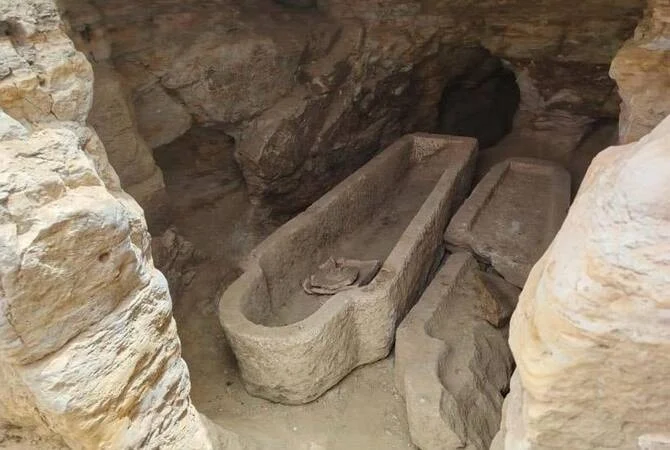
The first and perhaps most striking find is a rock-cut tomb dating to the Late Period. The structure is accessed via a square shaft reaching approximately 10 feet into the bedrock. This shaft serves as the gateway to two separate burial chambers, each offering a distinct narrative of family lineage.
- The Western Chamber: Excavators recovered a single limestone sarcophagus containing a well-preserved mummy, intricately wrapped in linen bandages.
- The Northern Chamber: This space served as a larger communal resting place, housing four additional limestone sarcophagi. Each contained linen-wrapped mummies, suggesting a generational burial plot intended for a single affluent family.
The Roman Stairwell Tomb
The second tomb represents the architectural evolution of the Roman period in Egypt. This structure features a formal staircase leading into a burial chamber. Interestingly, the interior lacks the elaborate funerary decorations typically associated with high-status Egyptian burials. Archaeological consensus suggests that this chamber, while prepared with structural intent, was likely never utilized for an actual interment, offering researchers a "frozen" look at tomb construction methods of the era.
The Roman Well Tomb
The third tomb, also dating to the Roman era, is centered around a rectangular well. This structure leads to a reception hall, which scholars believe served as a staging area for mortuary rituals—specifically, the preparation of the deceased for the journey into the afterlife. Two chambers connected to this hall yielded fragments of sarcophagi, hinting at the potential for further structural remains hidden beneath the desert sands.
Supporting Data: Artifacts and Artistic Expression
The discovery is defined as much by the contents of the tombs as by the structures themselves. The mission unearthed a cache of items that provide a clear picture of the daily and ritual lives of the oasis inhabitants.
Material Culture and Votive Offerings
The recovery of pottery vessels, flasks, and plates suggests a culture that prioritized the inclusion of domestic items in the afterlife. Furthermore, the discovery of limestone and sandstone offering tables indicates a continued adherence to traditional funerary cults.
Perhaps most compelling are the small terracotta votive figurines. These delicate pieces—depicting both maternal figures and stylized animals—offer a departure from the rigid, canonical art found in the royal centers of Thebes or Memphis. These figurines speak to a "local" artistic identity that flourished far from the direct oversight of the pharaonic court.
The "Oasis Style": A Deviant Artistry
Dr. Hassan Selim, a noted Egyptologist, highlighted the unique aesthetic of the Sheikh Sobi artifacts. He noted that the craftsmanship does not always align with the classical artistic canons taught in the royal workshops. Instead, the Bahariya artifacts exhibit a distinct, regional character. This "Oasis Style" indicates that local artisans were not merely copying metropolitan trends but were actively innovating, reflecting the unique religious beliefs and the day-to-day realities of life in a remote desert oasis.
Official Responses and Methodology
The success of this mission is a testament to the rigorous protocols of the Egyptian Ministry of Tourism and Antiquities. Sabri Farag, in his capacity as the head of the mission, underscored the dedication of his team. For three months, forty archaeologists, surveyors, and laborers worked under the intense desert sun to clear the site and document the finds in situ.
The methodology employed during the excavation was intentionally conservative to ensure the preservation of delicate linen wrappings and fragile limestone fragments. By documenting the exact spatial relationships between the sarcophagi and the ritual offering tables, the team has managed to reconstruct a portion of the funerary liturgy that once took place within these chambers.
Historical and Scientific Implications
The Sheikh Sobi discovery serves as a bridge between the terminal years of the Late Period and the integration of Egypt into the broader Roman Mediterranean world.
Religious Continuity and Change
The presence of mummification practices during the Roman period—even when mixed with Roman-style architectural features like stairwell access—proves that the ancient Egyptian religion remained a potent force in the lives of the oasis dwellers long after the political fall of the pharaohs. The transition from rock-cut family chambers to well-based Roman shafts marks a shift in how families interacted with their ancestors.
Economic and Strategic Connectivity
The Bahariya Oasis was never an isolated backwater. It was a vital link in the trade routes connecting the Nile Valley to the Western Desert and the Mediterranean. The wealth displayed in these tombs—the limestone sarcophagi, the specialized pottery, and the imported sandstone—suggests that the oasis governors maintained a high level of economic prosperity. The ability to fund such elaborate burial structures during a period of transition (the move from the 26th Dynasty to the Persian and then Roman eras) speaks to the resilience of the local economy.
Conclusion: The Ongoing Story of Bahariya
As the artifacts undergo cleaning and preservation in regional laboratories, the work at Sheikh Sobi is far from over. The Ministry of Tourism and Antiquities has expressed hope that further excavation in the surrounding area will reveal more about the social hierarchy of the oasis.
The site stands as a poignant reminder that history is not just found in the golden masks of kings, but in the family vaults of priests and local administrators who maintained the fabric of Egyptian society for millennia. Through these three tombs, we are invited to reconsider the "Late Period" not as a time of decline, but as a period of persistent cultural vibrancy, where the echoes of ancient traditions continued to resonate in the quiet, shifting sands of the Bahariya Oasis.
For the international archaeological community, the Sheikh Sobi mission provides a critical data point in the study of provincial Egypt, reminding us that the story of the pharaohs is far from fully told. As researchers continue to analyze the terracotta figurines and the linen-wrapped remains, they may find that the true secret of the oasis lies not in the wealth of its tombs, but in the enduring spirit of its people.
