

By Joe Burns | Facilities Dive
Published July 31, 2026
In a significant push to modernize public infrastructure and meet ambitious climate goals, the Commonwealth of Massachusetts has announced a major influx of funding for decarbonization projects across its public university and recreational facilities. The initiative, spearheaded by the Department of Energy Resources (DOER), provides state grants covering up to 45% of total project costs, specifically targeting the transition from fossil-fuel-dependent heating and cooling systems to high-efficiency, electric alternatives.
The funding, awarded under the "Leading by Example" (LBE) Decarbonization Implementation Program, marks a strategic turning point for the state’s public sector energy policy. By focusing on large-scale mechanical retrofits, the state aims to slash its on-site greenhouse gas emissions by 35% by the year 2030, a mandate established by Executive Order No. 594.
Main Facts: A Blueprint for Industrial Decarbonization
The grants represent more than just financial aid; they are a deliberate investment in emerging technologies that have yet to see widespread adoption in the United States. The state’s funding strategy prioritizes high-impact projects that demonstrate the viability of industrial heat pumps, geothermal networks, and sea-water-based cooling systems.
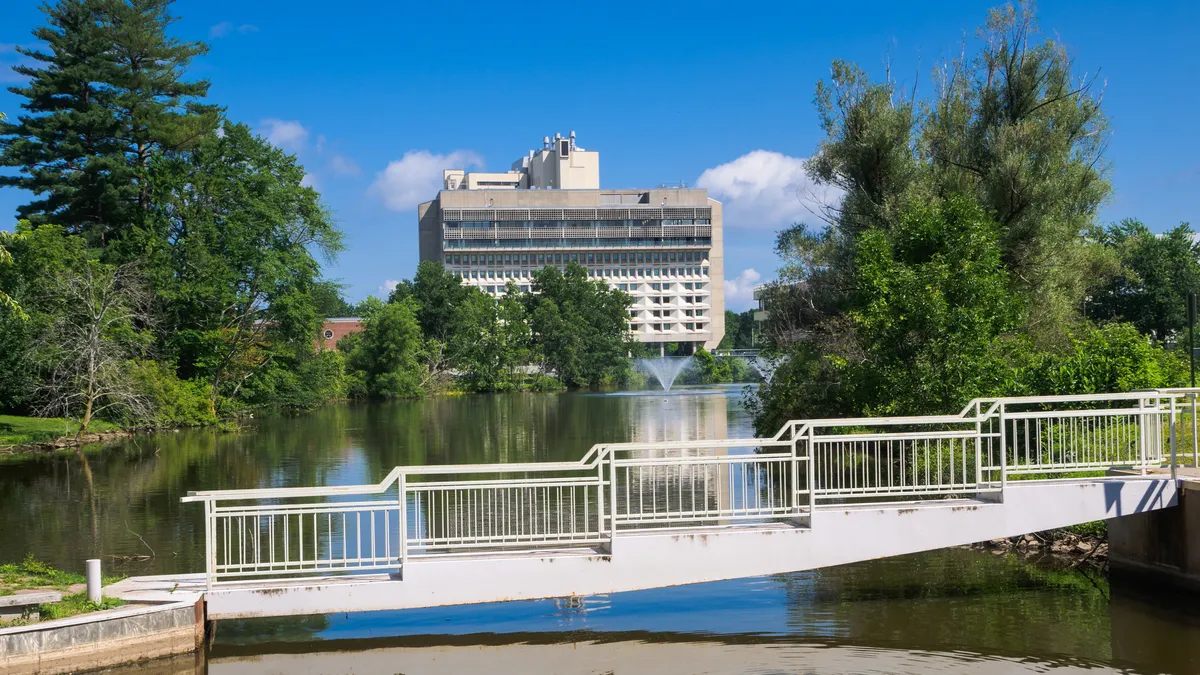
The most prominent award, totaling $7.35 million, was granted to the University of Massachusetts Amherst. The flagship campus will utilize these funds to install a 5-megawatt (MW) industrial heat pump at its central heating plant. This system is designed to capture waste heat and convert it into low-pressure steam—a process that remains rare in the U.S. industrial landscape. With fewer than two dozen such systems currently operational across the country, UMass Amherst is effectively positioning itself as a national pilot site for large-scale campus decarbonization.
Other notable awards include $5.3 million for UMass Boston’s campus-wide energy overhaul and $1.1 million for geothermal integration at UMass Dartmouth. Furthermore, the Division of Capital Asset Management and Maintenance (DCAMM) has secured $7.5 million to expand geothermal capabilities at the Massachusetts Maritime Academy and Salem State University.
Chronology: The Road to 2030
The trajectory toward this funding announcement began with the formalization of Executive Order No. 594, which mandated that state agencies take a proactive role in reducing fossil fuel reliance. Over the past three years, the Commonwealth has systematically audited its portfolio of public buildings to identify the "low-hanging fruit" for energy retrofits.
- Early 2024: The state initiated energy audits across the UMass system and the Department of Conservation and Recreation (DCR) facilities to determine baseline emissions.
- Late 2024 – Mid 2025: The LBE Decarbonization Implementation Program was established, creating a framework for grant applications that require institutional commitment to long-term carbon reduction.
- July 2026: The official announcement of the current funding cycle, confirming that the state would cover nearly half the capital expenditure for the selected projects.
- Future Outlook (2027-2030): Construction phases are expected to commence, with the goal of bringing the new heating and cooling systems online in time to meet the 2030 emission reduction targets.
Supporting Data: Targeting the Largest Emitters
The selection of projects was not arbitrary. The state’s energy analysts focused on facilities with the highest carbon intensity—specifically those relying on outdated natural gas boilers.

At UMass Boston, the decarbonization plan involves replacing existing gas boilers with three advanced electric heat shift chillers. These units will leverage the campus’s existing seawater intake infrastructure to regulate building temperatures. Projections indicate that this switch alone will reduce the campus’s natural gas consumption—and the resulting greenhouse gas emissions—by over 50%.
Similarly, the Department of Conservation and Recreational Services (DCR) is targeting its ice rink portfolio. Despite their smaller footprint compared to major university campuses, these rinks are disproportionately large consumers of fossil fuels due to the intense energy required for refrigeration and ice maintenance. By replacing gas-fueled heating systems with variable refrigerant flow (VRF) systems and energy recovery ventilation, the state aims to transform these rinks into "proving grounds" for similar recreational facilities across the state.
Key Financial Allocations
- UMass Amherst: $7.35M for a 5-MW industrial heat pump.
- UMass Boston: $5.3M for a campus-wide electric heat shift chiller system.
- DCAMM (Maritime Academy & Salem State): $7.5M for campus-wide geothermal infrastructure.
- UMass Dartmouth: $1.1M for geothermal system expansion.
- DCR Recreational Sites: Approximately $1.8M in aggregate for energy retrofits across three sites, including skating rinks.
Official Responses: Aligning Policy with Action
The initiative has garnered support from the highest levels of the state’s environmental leadership. Rebecca Tepper, Secretary of the Executive Office of Energy and Environmental Affairs, framed the grants as a necessary evolution for the state’s educational institutions.
"These grants represent major steps toward cleaner heating and cooling technologies, with our colleges and universities leading the way," Tepper stated. "By investing in these projects, we are proving that we can meet our climate obligations while simultaneously upgrading the infrastructure that supports thousands of students and residents."

State energy officials noted that the "Leading by Example" program serves a dual purpose: it reduces the state’s own carbon footprint and creates a local workforce trained in the installation and maintenance of modern thermal technologies. The program is specifically designed to alleviate the financial burden on public institutions that might otherwise be unable to afford the high upfront costs of high-efficiency equipment.
Implications: A Model for National Public Infrastructure
The implications of this funding cycle extend far beyond the borders of Massachusetts. As universities and public agencies nationwide grapple with aging infrastructure and rising energy costs, the Massachusetts model offers a roadmap for transition.
1. Scaling Industrial Heat Pumps
The successful implementation of the 5-MW heat pump at UMass Amherst could serve as a case study for industrial facilities across the country. If the project demonstrates consistent reliability and efficiency, it could lower the barrier to entry for other large-scale institutions looking to move away from steam-based heating.
2. The Geothermal Pivot
The integration of geothermal energy at the Massachusetts Maritime Academy and Salem State underscores a shift toward ground-source energy as a foundational utility. By connecting multiple buildings to a single geothermal loop, these universities are creating a resilient energy network that is less susceptible to the volatility of global fossil fuel markets.
3. Proof-of-Concept for Recreational Facilities
The DCR’s commitment to retrofitting ice rinks is particularly significant. Ice rinks have historically been difficult to decarbonize due to the specific thermodynamic requirements of maintaining ice surfaces. By testing VRF systems and energy recovery ventilation, the state is developing a template that municipal governments in colder climates can replicate to improve their own public amenities.
4. Economic and Workforce Development
While the primary goal is environmental, the economic impact is non-trivial. The installation of these systems requires specialized engineering and labor, fostering a niche market for "green-collar" jobs in Massachusetts. The state’s commitment to covering up to 45% of costs acts as a catalyst, encouraging institutions to prioritize projects that might have been delayed indefinitely due to budgetary constraints.
As the 2030 deadline approaches, the success of these projects will likely determine the future trajectory of state-level energy policy. By treating its campuses as living laboratories, Massachusetts is not just upgrading its facilities; it is attempting to rewrite the standard for how public institutions can participate in the global energy transition.
